Fusion or Replacement? How Surgeons Choose for Big Toe Arthritis
big toe arthritis surgery
By the time someone with a stiff, aching big toe sits down with a surgeon, they’ve usually read about both operations already. One keeps the joint moving. The other locks it solid. On paper that looks like an easy call, because who would choose less movement? In the consulting room it rarely plays out that way.
Hallux rigidus, the medical name for arthritis at the base of the big toe, wears away cartilage in a joint that bends every time you push off the ground. In the early stages, shaving away bone spurs (a cheilectomy) can buy years of comfort. Once most of the cartilage has gone, the conversation shifts to fusion or replacement, and the right answer depends far more on the person than on the X-ray.
Why fusion is still the default for advanced arthritis
Fusion remains the procedure most foot and ankle surgeons reach for when the joint is badly worn. The damaged surfaces are removed and the two bones are held together with a plate and screws until they heal into one solid piece, usually over six to twelve weeks. Patients are often surprised by how little they miss the movement. The toe was barely bending anyway, and with no joint surface left to grind, the main source of pain is usually gone.
For many people considering big toe arthritis surgery, that reliability decides it. Fusion has decades of track record, holds up well under heavy daily loads, and copes with toes that have drifted out of alignment or lost some bone quality. Walking, gym work, golf and even running are realistic goals for a lot of patients once the bone has knitted.
Footwear is where people feel it. A fused toe sits at a fixed angle, so heels higher than a few centimetres become awkward, and some people notice it when kneeling, squatting or walking down a steep slope.
What joint replacement offers, and where it falls short
Replacement keeps motion in the joint, which is exactly why it appeals. The surgeon resurfaces one or both sides of the joint with an implant (metal in most designs, a synthetic cartilage-like material in others) so the toe can still bend through push-off.
Big toe implants haven’t matched the long-term record of hip and knee replacements, though. Loosening, the implant sinking into the bone, and stiffness returning over time are all known problems. If an implant does fail, converting to a fusion later can be more involved, because some bone has already been removed. Plenty of patients do very well with one. Careful selection is most of the story.
The typical candidate has reasonable bone quality, a well-aligned toe and a real need for movement through the joint, whether that comes from footwear, dance, yoga or a sport that demands full push-off.
What a surgeon is weighing up
No single factor settles it. A surgeon will usually look at:
- How far the arthritis has progressed, including whether the small sesamoid bones under the joint are affected
- Bone quality and the alignment of the toe
- Daily demands, since a tradie climbing ladders all day loads the toe very differently from someone who mostly walks the dog
- Footwear priorities, which matter more to some patients than they first admit
- Any previous surgery on the same joint
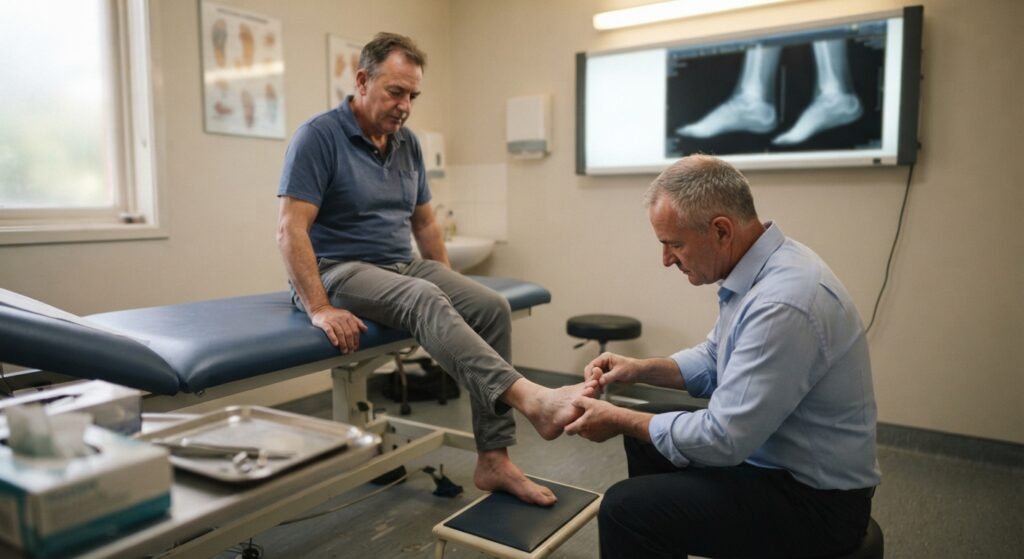
Weight-bearing X-rays show the state of the joint, and a hands-on exam shows how much movement is left. The rest comes from questions about what the patient actually wants to get back to. Two people with near-identical scans can walk out with different recommendations, and both can be right.
Recovery looks different for each
Fusion asks for more patience early on. Most patients spend around six weeks in a stiff-soled post-operative shoe with protected weight-bearing while the bone unites, and everyday activities come back gradually over three to four months. Swelling can hang around for longer than that.
Replacement often feels easier in the first few weeks, since there’s no bone waiting to fuse. The work comes later. The toe needs regular movement exercises to hold on to the motion the implant was chosen to preserve, and skipping them tends to show.
Neither path is a quick fix, and timelines vary with the procedure and the person. The better choice is the one matched to how someone uses their feet, not the one that sounds less permanent. If big toe pain is shaping your days, book an assessment with a specialist foot and ankle surgeon and bring a list of the activities you most want back, so the recommendation is built around them.
About The Author